
“Pain is inevitable. Suffering is optional. Say you’re running and you think, ‘Man, this hurts, I can’t take it anymore. The ‘hurt’ part is an unavoidable reality, but whether or not you can stand anymore is up to the runner himself.”
― Haruki Murakami, What I Talk About When I Talk About Running
Compartmentalization is a grieving mama’s best friend.
Like yesterday, out at lunch with a friend at a garden cafe. A family sat next to our table with their little boy. Nahara began playing with him happily. I saw that he was just learning to walk, and that his delicate blond curls were just beginning to hang below the nape of his neck. Like Shefa. I asked how old he was. 13 months. Like Shefa.
I gave my friend a brief look and she put her hand on my knee. My eyes began to fill with tears but I blinked them back easily. I was not going to go there. Not at the end of my lovely lunch with my friend. Not when I still had several more things to accomplish that day. And not because I’m all about repressing my feelings (I am SO not.) Just because no. I didn’t need to go there then. Mama says: Redirect.
But I would return to it later, check in with myself, to keep myself off that slippery slope between compartmentalizing and repressing. It pains me that Shefa is forever frozen at 12 months and 3 weeks in my mind. That children that are the age he died are the ones that remind me of him the most.
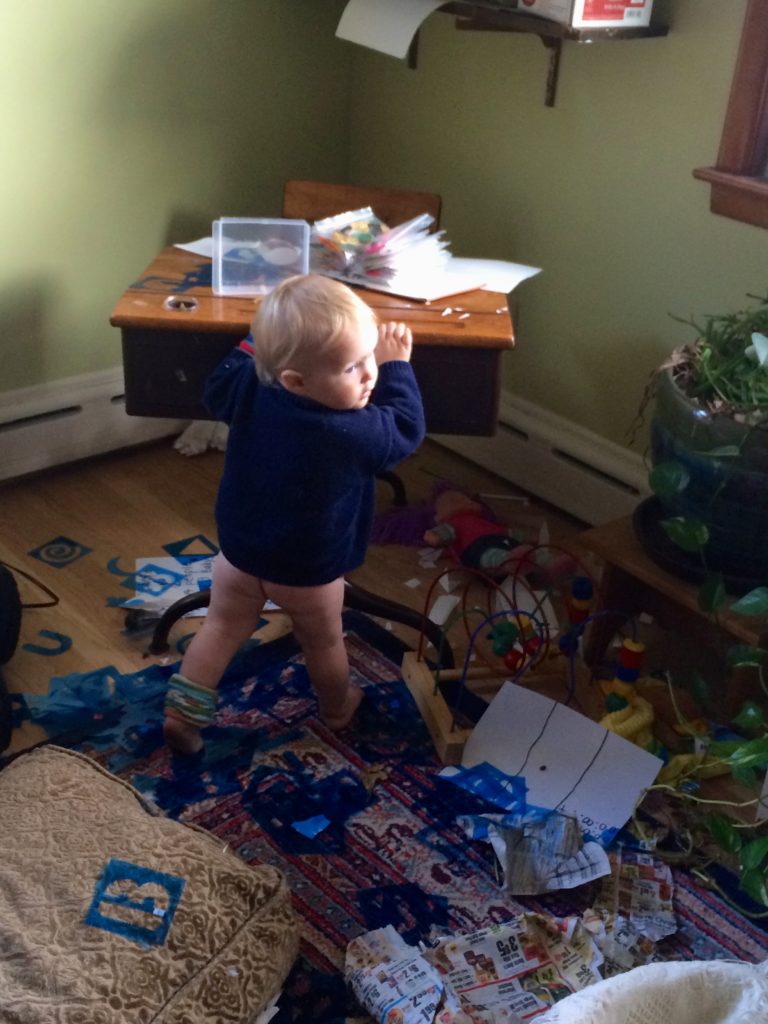
Less than 2 weeks before he died; this corner had been perfectly tidy moments before I snapped this shot.
If he were alive he would be 19 months. He would be walking confidently, running even. Talking. If he were on schedule with his sister he would be potty-trained. His hair would be down to his shoulders. He would be spending his time at the cafe exuberantly knocking this other sweet little blond kid over, smearing food everywhere, climbing up onto the empty tables and rattling the umbrella poles, visiting with the other customers, and drinking the dirty fountain water behind my back. He was like that.
But he’s not doing those things. He won’t ever, and the truth is that I really don’t know what he would be doing. Because that part only ever existed in my imagination as a fantasy. Not indulging this fantasy is the most powerful place of “not going there” that I practice these days.
The morning he died, when everything had been done to try to revive him and we finally left the emergency room, I remember crossing the hospital threshold into the stupidly beautiful Santa Cruz morning. The sky was so blue. We had arrived there in the dark, just before dawn, and even the change in light was disorienting. It was a fresh, bright, new day and nothing made sense. I remember thinking, this is like the part in the movie where someone dies. And then, this is happening to me, this is actually happening. And again, This is not happening, this can’t be happening. His body was behind me, and I was walking away. I was deep in shock and had a long way to go towards integration. I still do.
A couple months later my mother said it was like reality split in two in that moment, and we were somehow caught in this reality where he was dead, but there was some parallel alternate reality where he was still alive and everything was still normal. It felt like that.
But that wasn’t true. This was the only reality I was living in, at least I the body, I the mother, I the human. There were no other choices. And I had to aggressively commit to this reality or risk losing my sanity. He is dead. He is dead. He is dead.
And so he isn’t 19 months old now. He never will be. Nahara will not grow up with a (living) brother 4 years younger than her, the age gap that we so painstakingly planned. We won’t see that beautiful body grow and stretch and learn. He won’t do anything that he didn’t do, at least not as Shefa the body, Shefa the human. His life on earth happened, and it is over. It was 1 year and 3 weeks long.
It turns out, reality really is the place of the least suffering. Not that it doesn’t take work to stay here. And not that it doesn’t hurt (it hurts like hell.) But reality also always stays the same. He is dead. What maddens and tortures me are the what if’s, the could’ve been’s, the should’ve’s. They not only madden and torture me, they are also a complete illusion. Useless except as fodder for more suffering, and nothing but the frantic motions of my mind trying to escape from reality. He is dead.
It also turns out that those decades of meditation practice really do come in handy. My mind is like an eager puppy, constantly sniffing down paths, and I am just as constantly bringing it back, learning what leads to suffering and what leads to joy (or, at least, sanity, or presence, or basic functioning.)
Not going there is about discerning what is the truth of my grief and what is the drama of my suffering. What is the pain that I honor, work with, and hold? And what roads do I not need to go down? The choices are made again and again and again. It’s exhausting and constant work, but less so than the alternative.
* * * * * * * * *
And then there’s the times I need to go there.
Because the point of it all is moving. What will keep me moving? Sometimes not going there is the answer. Sometimes going there is.
A couple days after I thought I finished this post, I spent almost an hour with a friend and her family. Her son is almost the exact age as Shefa, her daughter within a year of Nahara. We are all good friends and our families are well matched. I’d spent months avoiding her son (and other kids Shefa’s age) after he died, but gave it up eventually. These kids were not Shefa and I was strong enough to manage being around them. Still, this was the longest and most intimate time I had spent with a kid his age.
The visit itself seemed fine. I enjoyed myself and was present. I didn’t go there. I didn’t need to. Her son was walking around bare-bottomed – he was potty trained by now. He was talking, eating, charming me, saying hi and bye. His blond curls were hanging to his shoulders. He played with his sister, squealing and giggling. Their lives were normal. It was all happening.
I went home after our visit and sat on the couch. As the hours passed I felt more and more like I was moving through a thick gel: slower, slower, slower. Until it finally hit me. This other child. His face. His body. Maybe if I hadn’t just been writing about what Shefa would be like were he still alive? Maybe if I hadn’t been so fucking spot on? But I had been. I needed to go there.
And so I walked directly to my room and closed the door. I leaned on the tall dresser that had become an altar of sorts, laid my head next to Shefa’s ashes, and wept. The tears were right there, they always are. When I got tired of standing and crying I sat in the glider to cry, clutching several bunched up sweaters to my heart, rocking and weeping. Everyone who has gone through this before knows that the sweaters were bunched to be roughly the size and shape of my lost child, that they were pressed against me as he would’ve been after nursing to sleep in that chair. Outside the window I heard my daughter squealing with joy as she bounced on the giant trampoline with her dad. I watched the trees, newly filled out with fresh spring leaves, bowing and swirling in the breeze. And I cried and cried and cried, as loud and long as I needed. I rarely cried like this alone. It felt good. My head was empty of everything, only sadness and the river of tears that I am constantly in. It washed my heart clean again until I could finally see it as it is: bruised, battered, stretched beyond belief, and full of love.
6 comments for “On Not Going There”